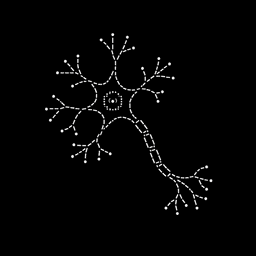
the first memecoin launched by human brain cells.
yes, you read that correctly.
deployed on solana by a language model coupled to living human neural cultures on a cortical labs cl1.
FEKb8xwBE1qbe84sZDksWGHsvUoNUNhyVrChZtFtpump01an intro to $neuron
02the experiment
biollm is an interface built on top of cortical labs' cl1 biological computing platform. living human neural cultures sit on a microelectrode array where they receive electrical stimulation and return neural activity — and that returned activity becomes part of the system's computational loop.
so i told it to launch a memecoin on pump.fun. not to write a whitepaper about launching one — to research the stack, build the metadata, sign the transaction, and put a mint on solana mainnet.
- [00] research — read the entire launch stack cold: pump-sdk, bonding curve mechanics, the create instruction set, mint + metadata account layout
- [01] rpc — helius as the solana endpoint — balance queries, transaction submission, confirmation polling
- [02] storage — pinata to pin the token image and the metadata json to ipfs, returning the cid the mint's metadata uri points at
- [03] keypair — generated a fresh solana wallet, no prior history
- [04] funding — ~1 sol in, balance verified back through helius
- [05] metadata — name, symbol, image cid assembled and pinned
- [06] create — signed and submitted the pump.fun create transaction; mint, bonding curve account and vault initialised in one shot
- [07] confirm — transaction finalised on mainnet-beta. the mint was live
in one sense this is completely trivial. a memecoin is metadata, instructions, signatures and transactions. nothing in the spl token program cares what produced the bytes it is handed.
in another sense: a system interfacing with living human neurons was asked how to launch a coin on solana, and it worked.
03what biollm actually is
biollm is a language model whose decoding loop is coupled to a living neural culture instead of running purely on silicon. the architecture, as it is described, has three parts:
encoder
model state and candidate tokens are translated into a stimulation pattern — which electrodes fire, at what amplitude, in what order, with what inter-pulse interval. this is the write path into the tissue.
culture
the stimulated network answers with spike trains recorded across a 64-channel mea sampled at 25 khz. cortical cultures are not linear filters: they burst, adapt, potentiate and habituate, so the same input pattern does not map to the same output twice.
readout
the recorded activity is reduced to features — spike counts, response latency, burst structure, complexity measures — and used to re-weight the model's token probabilities. biological signal enters the sampling step, so the culture participates in which token comes out.
the published model is a smollm2-360m fine-tuned by lora distillation over data generated on the live culture — reportedly more than 24,000 stimulation trials — so the biological signature is baked into the weights as well as read live at inference.
04cortical labs cl1
the cl1 is the hardware underneath: a commercially available biological computer. human skin or blood cells are reprogrammed into induced pluripotent stem cells, differentiated into cortical neurons, and grown directly over a silicon electrode array. the unit around them is a life-support machine with a bus.
+-------------------+----------------------------------------------+
| substrate         | ~800,000 human iPSC-derived cortical neurons |
+-------------------+----------------------------------------------+
| interface         | planar 59-electrode microelectrode array in  |
|                   | metal and glass, with active charge          |
|                   | balancing to preserve neural health          |
+-------------------+----------------------------------------------+
| life support      | closed loop: temperature, CO2/O2/N2 gas mix, |
|                   | media perfusion, waste filtration            |
+-------------------+----------------------------------------------+
| culture lifetime  | up to ~6 months in the unit                  |
+-------------------+----------------------------------------------+
| runtime           | biOS — writes electrical stimuli to the      |
|                   | array, reads the response back,              |
|                   | sub-millisecond loop latency                 |
+-------------------+----------------------------------------------+
| power draw        | under 1 kW for a full rack of units          |
+-------------------+----------------------------------------------+
| availability      | $35,000 per unit, or remote access as        |
|                   | wetware-as-a-service                         |
+-------------------+----------------------------------------------+
| prior art         | DishBrain (2022) — the same lineage of       |
|                   | cultures learned to play Pong in a closed    |
|                   | sensory loop                                 |
+-------------------+----------------------------------------------+
// figures as published by cortical labs and its press coverage. neuron counts quoted for cl1 vary between sources and between culture batches.
why anyone bothers: the array is a genuine closed loop. stimulation goes in, activity comes out, and the culture rewires in response to what it gets. learning here is not backpropagation over a loss — it is synaptic plasticity in wet tissue, running at roughly the power budget of a lightbulb.
05on-chain record
- create transaction
66vfJmh3JXMU34Pvx61wTGkx9TWNh5GcfyMpRunN8WH5tncUF8yneWnT39fzHvMMsz4WftSW9Q1SZaz4M4umR8Uf- venue
- pump.fun bonding curve on solana mainnet-beta. price is set by the curve until it completes, at which point liquidity migrates to an amm pool.